

The Emerging AI Dentist
Artificial intelligence is now a reality in dentistry, moving beyond hype into practical applications in dental practices and education. From 2024 to 2025, AI integration shifted from pilot programs to standard workflows, aiding tasks from diagnostics to treatment planning. The goal isn't to replace dentists but to equip them with tools that enhance precision, efficiency, and patient care.
AI development is rapid. A few years ago, AI dental tools were theoretical; now, algorithms analyze radiographs, personalize treatment plans, and simulate surgical procedures. We anticipate further refinement of existing technologies and new AI solutions that will alter how dentists are trained and practice.
Dental education must evolve with this shift. Schools recognize the need to prepare future dentists for a world where AI is an integral part of their toolkit. This involves understanding AI's capabilities and limitations and learning to leverage it effectively—a skill essential for success. This change requires technical expertise and a critical approach to evaluating and implementing new tools.
AI-Powered Diagnostics: Seeing What Was Missed
AI's significant application in dentistry is diagnostics, particularly analyzing radiographic images. AI algorithms identify subtle patterns and anomalies that the human eye might miss, leading to earlier, more accurate diagnoses for conditions like caries, periodontal bone loss, and early oral cancer.
These algorithms train on vast radiographic image datasets to recognize disease signs. AI can detect subtle bone density changes indicating periodontal disease, often before clinical signs appear. It also identifies early caries lesions difficult to see with traditional methods, reducing false negatives and allowing timely intervention.
Companies are developing AI diagnostic tools for dentistry. Overjet, for example, provides an AI platform for dental insurance review and clinical decision support, analyzing X-rays to identify and quantify dental conditions. A study by Augusta University Dental College in the Journal of the American Dental Association showed AI's potential to improve radiographic analysis accuracy and efficiency. Researchers found AI algorithms detected caries with accuracy comparable to experienced dentists, but much faster.
Benefits extend beyond identifying problems. Earlier detection leads to less invasive treatments, better patient outcomes, and potentially lower healthcare costs. AI acts as a preventative tool, shifting focus from treating disease to preventing it.
Simulated Patients: Perfecting Skills Risk-Free
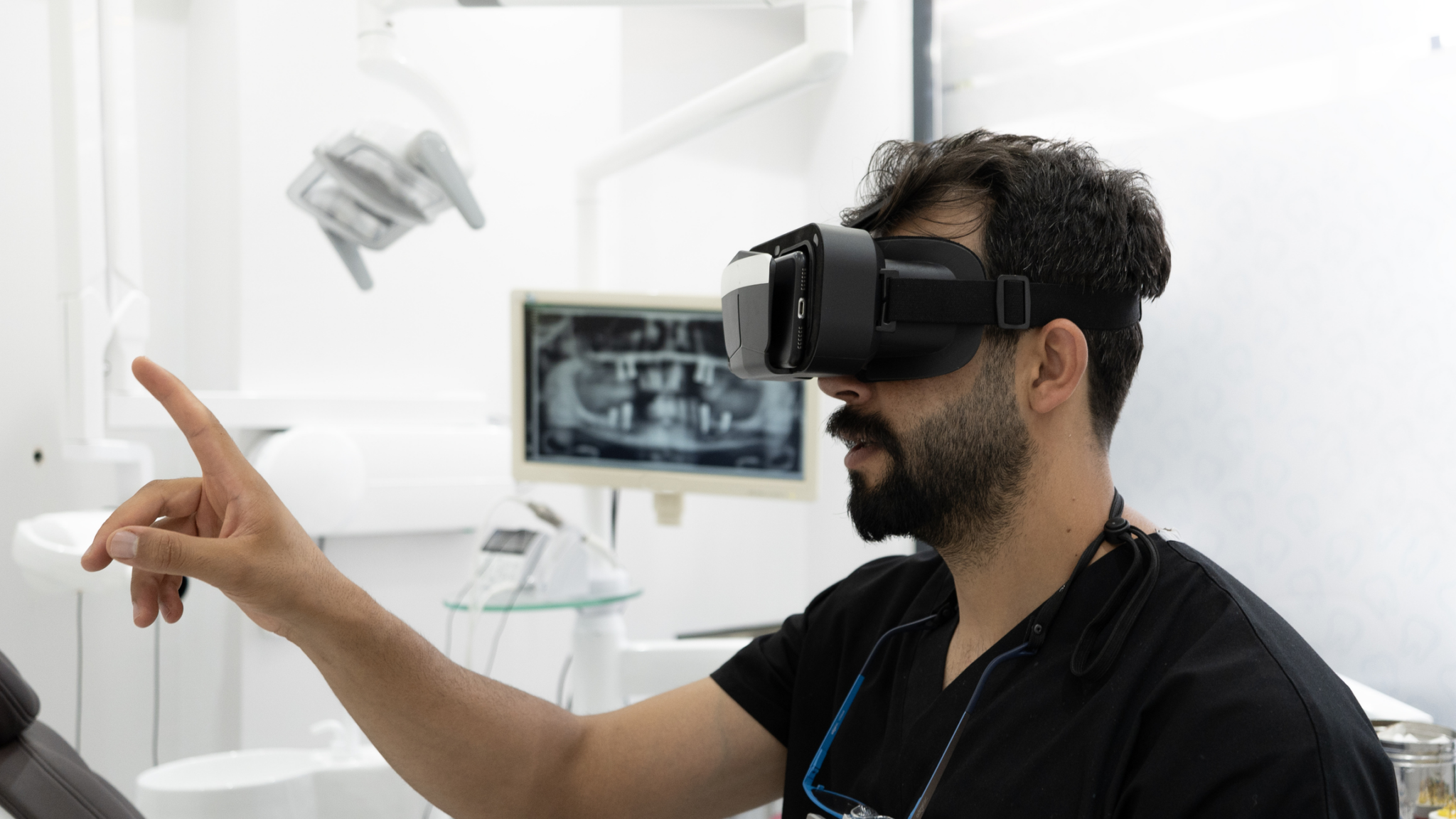
The traditional chairside learning model, while essential, faces limitations due to patient availability and the risks of students practicing on real individuals. AI-driven virtual reality (VR) and augmented reality (AR) simulations offer a solution, providing a safe, controlled environment for students to hone procedural skills.
These simulations allow students to practice dental procedures—from cavity preparation and root canal treatments to implant placement—without risking patient harm. The simulations are highly realistic, replicating the tactile feel of working with different materials and tissues, and offer personalized feedback on areas needing improvement.
Repeatable scenarios are a major advantage, allowing students to practice procedures multiple times to refine technique and build confidence, especially for complex, high-precision tasks. However, replicating exact tactile feedback of real clinical procedures remains a challenge.
Companies like SimX and FundamentalVR develop sophisticated VR simulations for medical and dental training. These platforms address limited clinical experience by providing students opportunities to practice and refine skills outside the traditional setting, which is important for students in dental schools with low patient volume.
Personalized Learning Paths: AI as a Tutor
Dental education is moving beyond a one-size-fits-all approach. AI enables adaptive learning platforms that tailor curricula to individual student needs and learning styles, assessing strengths and weaknesses to identify areas of excellence and struggle.
Based on assessment, the platform adjusts material difficulty and content, providing targeted support and personalized learning pathways. This ensures students are challenged appropriately and receive needed help, moving beyond content delivery to actively assessing and responding to student performance.
AI tools can assist students preparing for board exams by generating practice questions, providing answer feedback, and identifying study focus areas. While the California Dental Association (cda.org) focuses on continuing education for practicing dentists, personalized learning principles apply to all dental education stages.
Ethical considerations are paramount. AI in education raises data privacy and algorithmic bias questions. Platforms must be designed and implemented to protect student data and avoid perpetuating inequalities.
The Future of Curriculum: What’s Changing?
Dental schools are adapting curricula to incorporate AI and prepare students for dentistry's future. This includes new courses on AI and data science, integrating AI tools into existing courses, and offering specialized tracks in digital dentistry focusing on AI and advanced technologies.
Skills for future dentists in an AI-driven world go beyond technical expertise. Critical thinking, problem-solving, and communication are more important than ever. AI can assist with diagnosis and treatment planning, but it cannot replace a dentist's sound clinical judgment and effective patient communication.
A shift from rote memorization to clinical reasoning and evidence-based practice is likely. Students must critically evaluate AI-generated information and integrate it into clinical decision-making. Continuous adaptation and learning are crucial as AI technology evolves.
The Dental Board of California (dbc.ca.gov) emphasizes continuing education for licensed dentists, underscoring lifelong learning in a rapidly changing field. This principle applies to dental students, who must embrace new technologies and adapt to evolving practice standards.
AI and the Dental Hygiene Profession
AI's impact extends to dental hygienists, transforming their roles and responsibilities. AI tools are being developed to assist with periodontal charting, oral cancer screening, and patient education.
AI helps hygienists identify inflammation and bleeding during periodontal charting for more accurate assessments. AI image analysis aids early oral cancer detection, potentially saving lives. These tools augment, not replace, dental hygienist skills.
Dental hygienists are training to use and interpret AI data for more informed, personalized care. While AI automates routine tasks, it creates opportunities for hygienists to focus on complex cases, better utilizing their
The future of dental hygiene will likely involve a greater emphasis on preventative care and patient education, with AI playing a key role in supporting these efforts. AI’s ability to analyze data and identify risk factors can help hygienists develop tailored prevention plans for each patient.
Navigating the Ethical Landscape
The integration of AI into dental education and practice raises important ethical considerations. Data privacy is a major concern, as AI algorithms require access to vast amounts of patient data. It’s crucial to ensure that this data is protected and used responsibly.
Algorithmic bias is another potential issue. AI algorithms are trained on data, and if that data is biased, the algorithm will likely perpetuate those biases. This could lead to disparities in care, with certain patient populations receiving less accurate diagnoses or less effective treatments. It’s essential to develop algorithms that are fair and unbiased.
There's also the risk of over-reliance on AI. Dentists and hygienists must remember that AI is a tool, not a replacement for clinical judgment. It’s important to maintain a healthy skepticism and to always verify the results generated by AI algorithms. The human element of care – empathy, communication, and critical thinking – remains essential.
Safeguards need to be in place to ensure that AI is used ethically and responsibly. This includes developing clear guidelines for data privacy and algorithmic bias, providing training for healthcare professionals on the ethical implications of AI, and establishing mechanisms for accountability and oversight. This isn't about hindering innovation, but about ensuring it benefits all patients.
What Schools Are Leading the Charge?
Several dental schools are at the forefront of AI integration, pioneering innovative programs and initiatives. The University of Southern California (USC) Herman Ostrow School of Dentistry, for example, has established a Center for Advanced Dentistry, which focuses on research and development in areas such as digital dentistry and AI. They’re actively exploring the use of AI in diagnostics and treatment planning.
Augusta University’s Dental College, as reported in Jagwire, has researchers actively studying the impact of AI on dentistry, specifically exploring how algorithms can improve radiographic analysis. Their research is contributing to a better understanding of the potential and limitations of AI in clinical practice.
These schools are not simply adopting AI tools; they’re actively collaborating with AI companies and researchers to develop new and innovative solutions. They’re also incorporating AI into their curricula, preparing students for the future of dentistry. The key takeaway is a focus on applied AI – using the technology to solve real-world clinical problems and improve patient care.
Other institutions are focusing on creating interdisciplinary programs, bringing together dental students with data scientists and engineers to foster collaboration and innovation. This collaborative approach is essential for unlocking the full potential of AI in dentistry.
No comments yet. Be the first to share your thoughts!